

 blossom
 Summary
Everything I’ve learned about interior design recently.
introduction
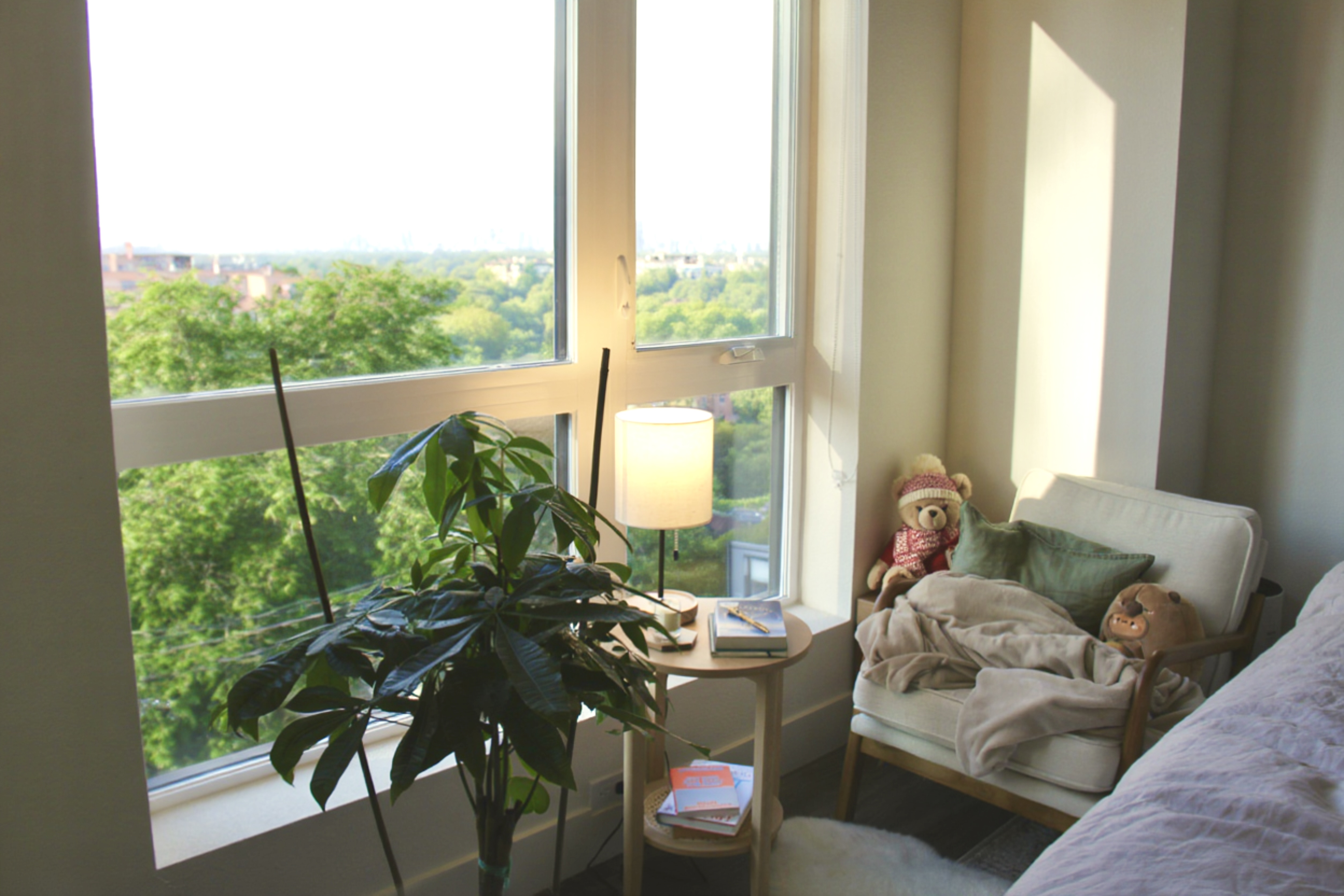 I moved to a new apartment this year! Although I’ve lived in a few different places by now, I previously hadn’t put very much thought into how I designed my physical space.
I didn’t originally plan on getting into interior design this time, either— but between all the amazing staging I saw during apartment tours and seeing our product designers’ level of obsession building the new office for work, I found the inspiration I needed to try taking it more seriously myself.
As much as I talk about space and urban design, I’d greatly underestimated how impactful my home environment was to my well-being. I think I’d internalized some false notion that if I spent most of my time outside or on a computer, it shouldn’t matter as much to me. I’m glad I’ve since dispelled that notion.
This page is an attempt to generalize my learnings about redesigning my physical space. I’m really happy with how my new apartment came together, and hope you’ll be able to find that same joy within your own space as well!
AI-generated content notice
To avoid doxxing myself, I’ve edited any images with windows or other identifiable features using Reve. Hopefully, this allows me to share pictures without giving random internet strangers the ability to find my exact apartment on Google Maps :)
goals and intentions
When designing a space (or anything, really), I like to start with the high-level question of who will use this, and what will they use it for? Will I expect to host others frequently? What do I want myself and others to feel when I walk into the room? What will I mostly be doing at home, and at what times?
Identifying a few objectives helped me a lot for my decision-making, especially around prioritizing what details to spend my limited time and budget on.
my priorities
For context, here were my three biggest goals for my new space, in rough order of importance. Your list will probably look different!
- Hosting: since I’m moving closer to work, friends, and family, I want to more regularly have people over. This signaled to me that I need to
- a) prioritize my living room space to comfortably support visitors, and
- b) provide a variety of excuses for people to come over (like displaying a bunch of board games, getting a game console, living in a convenient location…)
- Organization: I’ve lived in very cluttered environments in the past. While I don’t have anything against that, I thought it’d be cool to figure out how to design an environment that I could more easily clean and maintain. The less I have to think about doing household chores, the better!
- Supporting hobbies: I spend most of my time at home reading, writing, or cooking, with aspirations to spend more time doing music-related stuff and playing more board/video games. Building a reading nook, finding a permanent spot in the living room for the piano, and making my desk a really inviting place to think+type help me spend more (and higher quality) time doing what I enjoy.
interior design is more art than science
At first glance, much of interior design seems wholly impractical. Why spend so much effort cluttering up your space with non-functional art or plants; why buy a fancy nightstand when a 5-gallon Home Depot Bucket provides exactly the same surface area for 1% of the cost?
But just like any other form of art, interior design serves its purpose as a form of self-expression. This landmark 2002 study found strong correlations between personality traits and cues from participants’ physical spaces: for instance, authors found an association between cluttered desks and high openness to experience. Likewise, it’s reasonable to suggest that someone with ten beanbag chairs in their living room might have high levels of extroversion; or someone with an alphabetically-organized bookshelf would have high conscientiousness.
That is all to say: have fun with it!! Living within a tangible, physical representation of myself that I can see/touch gives me a baseline level of happiness that’s hard to describe in words. If the Home Depot Bucket nightstand really is your vibe, go for it— no decision is a wrong decision as long as you chose it deliberately.
setting a budget
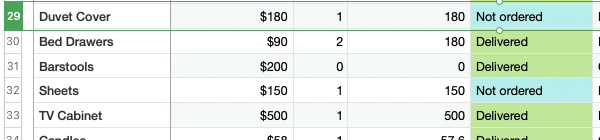 Furniture can get really, really expensive. Unless you have unlimited money, deciding how much you want to spend on a space instantly filters down the infinite number of options out there. (See the furniture shopping section for more details on this process.)
I used the anchoring strategy to help manage this better: by choosing to spend most of my time and money researching the best options for one or two large items in each room, I could get away with buying cheaper, more generic items to complement them. As an example, I spent nearly half of my bedroom budget on my bed, and surrounded it with random furniture from Amazon and IKEA— as long as they were also natural-wood-themed, they fit in perfectly!
A good place to start is to make a list of every major furniture purchase you’re planning, the maximum amount you’re willing to spend for each, and how necessary each one is. I did this and realized the total exceeded my budget, so I adjusted the less-important items I was OK cheaping out on (picture frames, desk lamps, nightstand…) and eliminated several splurges I couldn’t justify (Apple Studio Display, robot vacuum…) to feel good about spending more on the items I had high conviction in (bed frame, nice keyboard, TV cabinet…)
great spaces are always work-in-progress
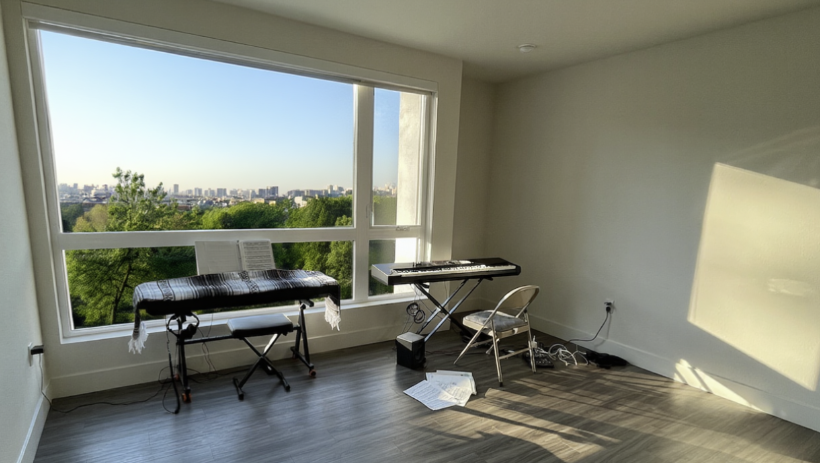 (above: apartment day one.)
It’s okay to take your time! Part of the fun of designing spaces is the gradual process of living in them and understanding them better. First paint in the wireframes and broad strokes, then fill in the details as time allows. Once in a while I look around and think “hey, that one thing feels a bit off” and create a cool little side project for future me.
Expect your goals, needs, and tastes to change over time. Spending a lot of money on buy-it-for-life furniture can be ideal in some situations, but be very confident that you’re OK with that object existing and defining your style for many years. Smaller, cheaper, and more portable pieces (like blankets, lamps, and wall decor) are good outlets for initial experimentation when you want to try something new. If I ever decide I get tired of green stuff, I’ll buy a new set of purple pillow covers or something.
important safety notices
When moving into a new place or doing anything new with large furniture:
- don’t touch live wiring!!! electricity can be dangerous. make sure you flip the breaker before any invasive procedures, and call an electrician if you’re unsure about anything you’re doing.
- If you’re in an apartment and aren’t allowed to nail tall bookshelves into the wall, get a pack of shims and put all of your heavy books on the bottom to avoid tipping risk. If you’re in Japan you can find some of these earthquake-proofing poles, which I would totally get if they were sold in the US.
- Make sure your smoke alarm + carbon monoxide detector exists and works, and you know where the fire extinguisher is. (Fire extinguishers make weirdly good housewarming gifts!)
- Get a stud finder and ensure you’re drilling holes for TV’s, shelves, and other heavy wall-mounted things in the right places. (Alternatively, use some drywall anchors.)
- While moving, protect your glass well and assemble all furniture on soft surfaces (like a furniture pad or rug).
functionality
The first half of interior design is making your space work well for your needs. (The second half is making things look good: see aesthetics if you want to skip ahead!)
divisions
(duplicating the cover image, since i think it’s a good enough example.)
The first question that came to my mind when I walked into my empty room for first time was: “where should i put everything??” which quickly evolved into the arguably more useful question: “what do I want to do in this space?”
As a basic example, I intend to use my room mostly for sleeping, sometimes for working, and occasionally for reading and relaxing. With those in mind, I felt it reasonable to divide the room into three main areas:
- The biggest portion of the room should be for the bed, nightstands, blanket storage, and anything else I’d need to get a good night’s sleep.
- The second-largest portion of the room should contain a desk, some shelves, and anything else I’d need for a functional work/writing setup.
- Whatever leftover portion of the room could host a comfy chair, small table, and anything else I’d need to unwind after a busy day at work. (This turned into my reading nook, which is pictured above.)
Here are a few concrete tips for actualizing the intention to divide up a space based on how it’ll be used. Well-placed partitions can actually make spaces feel larger overall!
Use furniture as movable partitions: Our kitchen and living room don’t have a wall between them, so we bought a few lounge chairs + a table and pointed them towards the rest of the living room. Visitors have to physically enter the living room by squeezing through them, which creates the illusion of a smaller, distinct space even though it’s part of a larger room.
Use rugs and vary floor surfaces: I have a 6’x9’ area rug under my bed (which extends a bit past it on the sides) that serves as a visual cue for dividing the “sleeping area” from the rest of the room. Similarly, the living room also has an area rug that creates a cozier, enclosed feel apart from the hard-floored kitchen. Softer floor materials are more relaxing and inviting, whereas harder floor materials can inspire action.
designing maintainable spaces
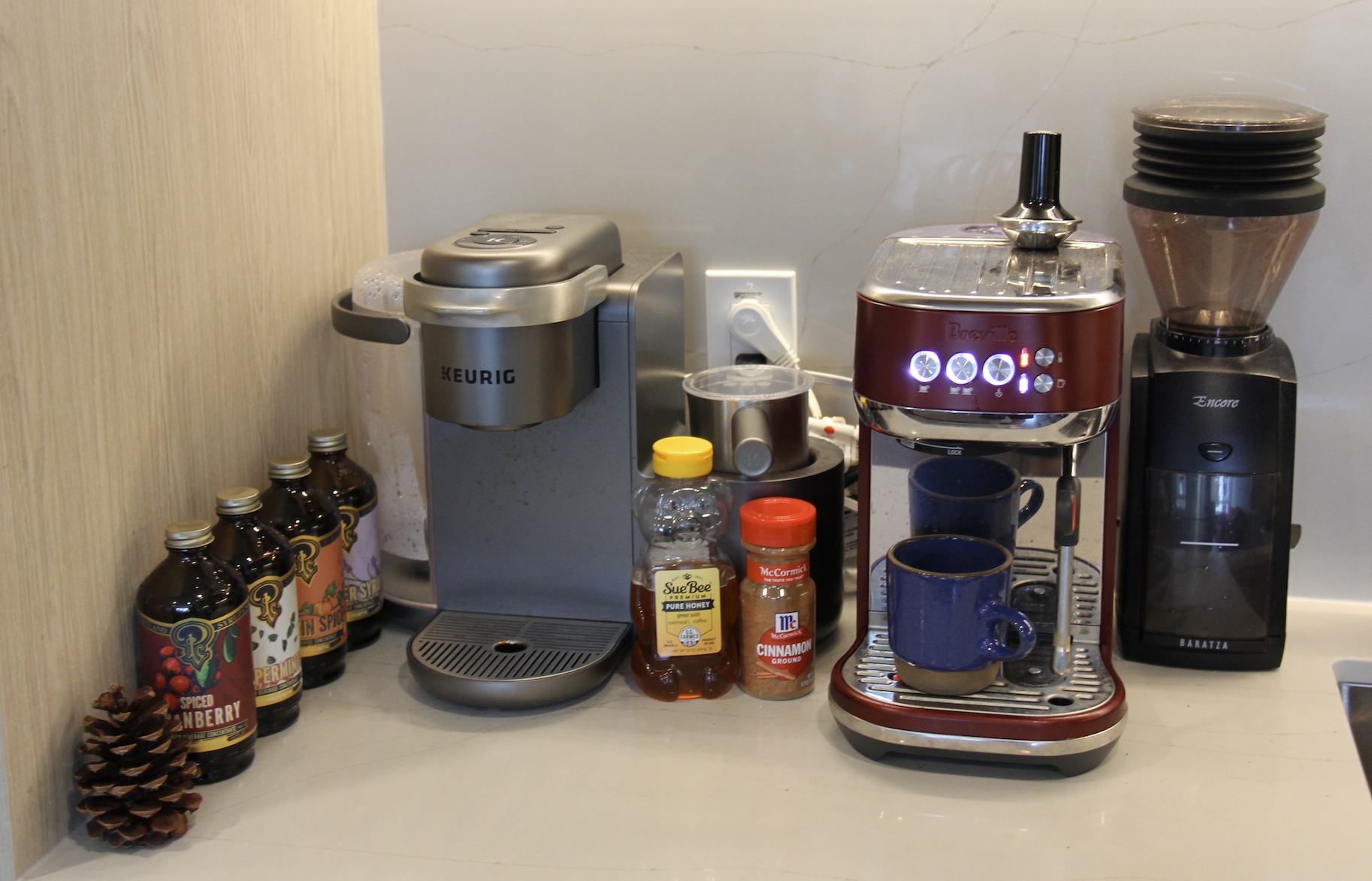 While meticulously-designed organization systems and “everything has a very specific labelled place they belong” philosophies can be helpful, I find it hard to keep up if they demand a lot of recurring work. Rather than focusing on creating a perfect system, I instead focus on the goal of minimizing the mental overhead of organization.
One of my favorite interior design concepts is the drop zone: similarly to desire paths, you’ll probably notice yourself starting to ignore whatever cabinets you designate for commonly-used items. You’ll leave your keys strewn across the counter after work, or throw your grocery bags onto the ground after a haul. Rather than fighting those desires, you could instead buy a cool vanity bowl to hold your keys where you drop them most, or get a box to throw totes into.
I really like the SKÅDIS pegboard from IKEA because it provides so many customizable drop zones. In the board below, I’ve got a shelf for my wallet/keys, a hook for grocery bags/headphones, and some clear boxes for whatever trinkets I feel too lazy to find a permanent spot for yet. IKEA offers a wide variety of first-party accessories; there are also lots of compatible 3D-printed parts floating around online (like the keyboard holder hooks I have). I don’t have to think about where to return any of these items after using them anymore; I can autopilot straight to the board!
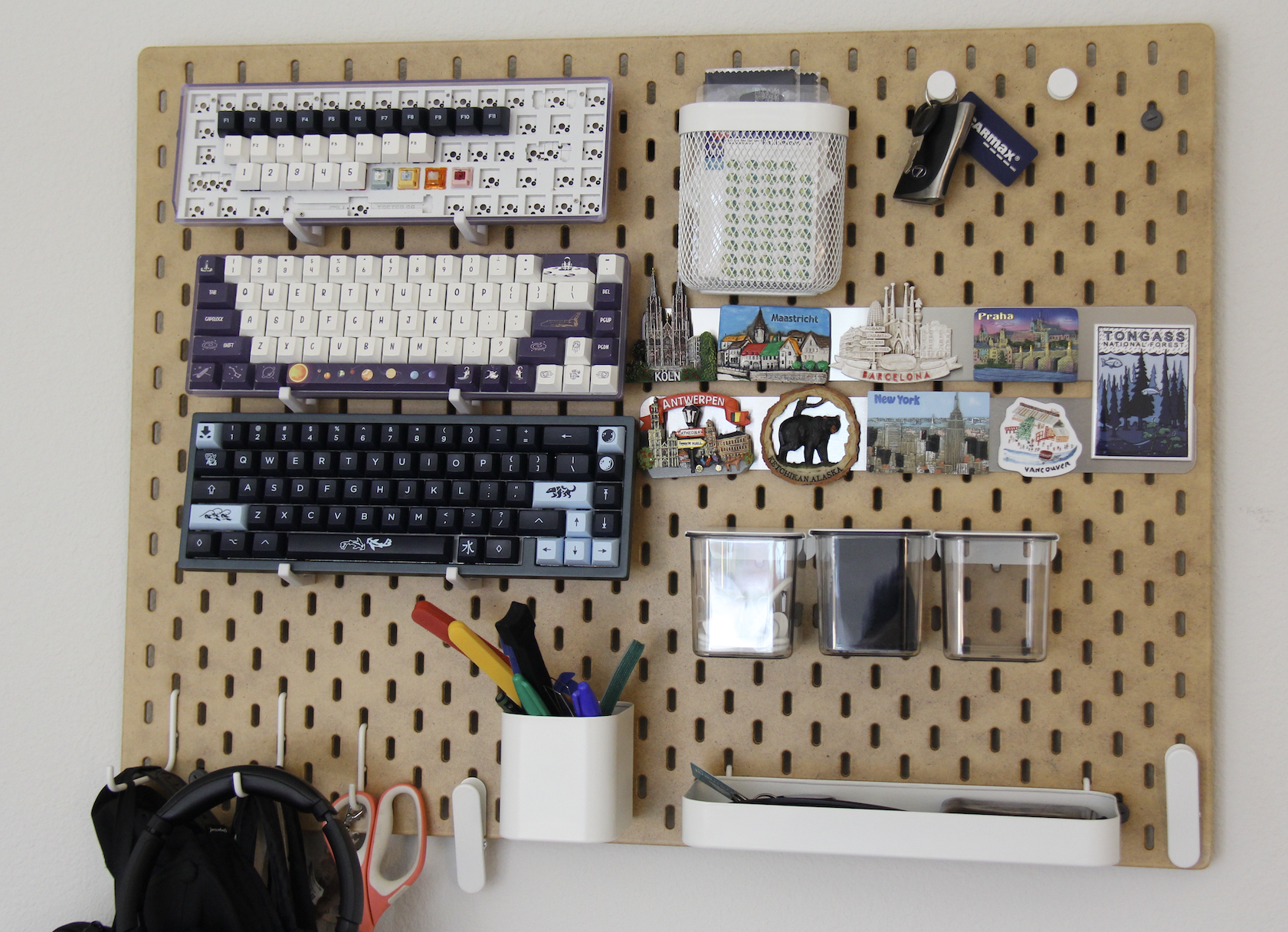
Another related tip I picked up is to organize by urgency rather than frequency. When deciding how to ration your most visible and accessible space, I ask myself: “if I need this thing, do I need it right away?” I keep things like coffee beans, spare batteries, and grocery bags within easy reach. Some frequently-used things like the rice cooker, vitamins, or vacuum cleaner can be stowed away since I’m in less of a rush when I’m looking for them.
interactivity
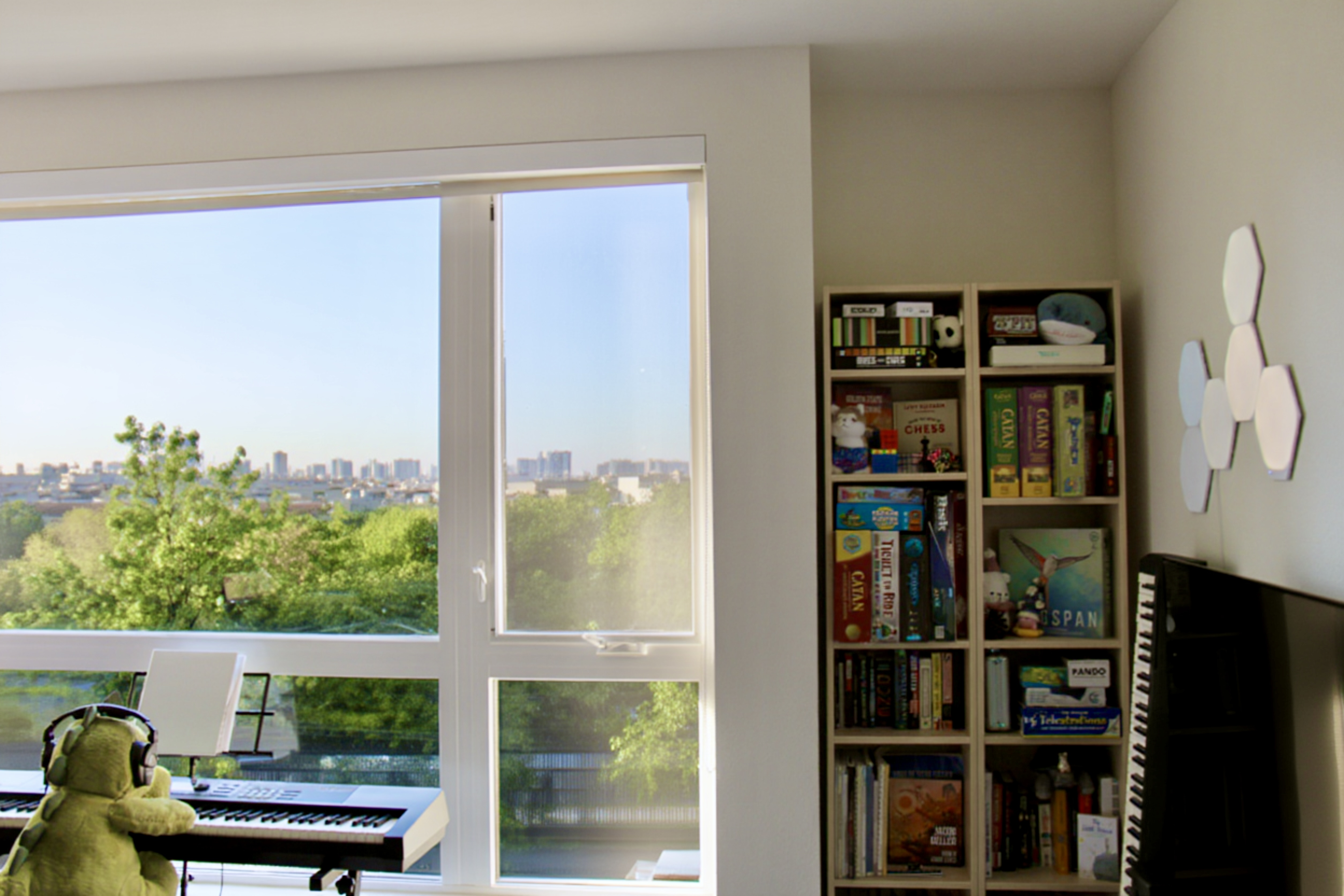 A great way to make a space feel more inviting and inspiring is to give yourself and guests lots of excuses to touch, change, and otherwise feel like an active contributor to the environment. There are lots of ways to do this (I’m sure you can think of a few that reflect yourself well!); here are my favorites:
- Keep some drinks, snacks, and/or a candy bowl in view of the entrance and invite guests to grab some when they enter.
- I mounted some nanoleaf hexagon lights on the wall that change color and intensity based on the noise level of the room. They sync well with music playing from the TV speakers nearby.
- The bookshelf is filled with books, games, Rubik’s cubes, and other things that can be played with in passing.
- The living room has some instruments lying around (so far the collection includes two keyboards, a bass guitar, and a cajon!)
Here are some ideas for a less active space meant for relaxation:
- Keep a box of throw blankets, floor pillows, and other soft things to grab.
- Scatter around some candles or scent diffusers that can be lit/turned on and off.
lighting
Lighting is a crucial variable that can completely change how a space works and feels.
The first thing to do is evaluate your sources of natural light (from sunlight through windows or skylights). What direction are your windows facing? Are your windows blocked by trees or other buildings? How does the lighting change over the course of a day? A great space will feel bright and well-lit during the entire day, but it’s often not something you have control over.
Once you understand your space’s interactions with natrual light, the next step is to layer in your artificial light for evenings, cloudy days, and dark spots in the room.
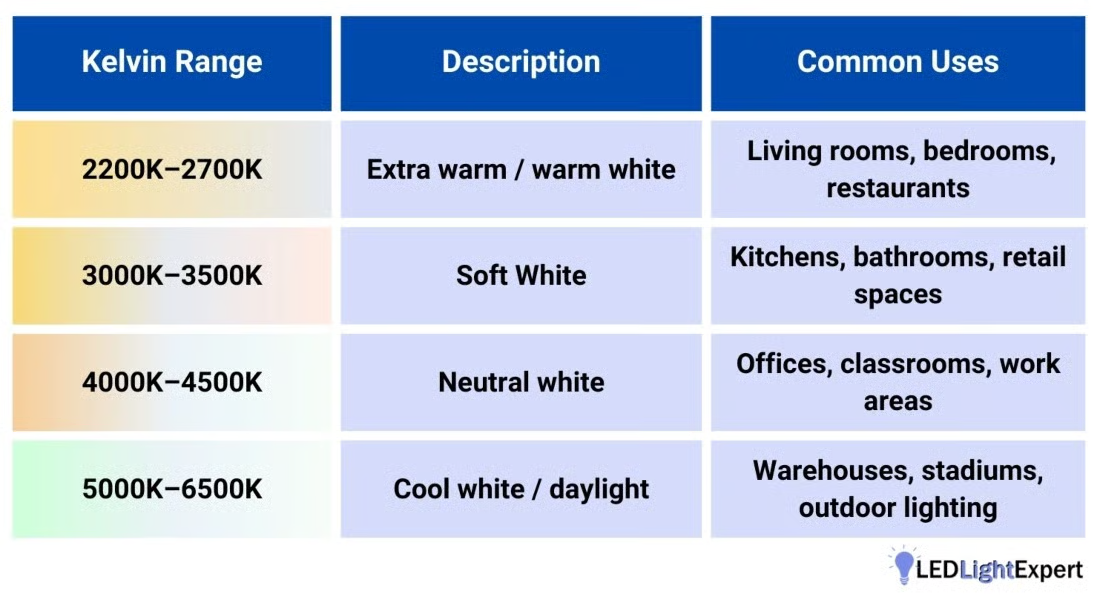
To experiment with lighting temperatures, I recommend picking up something like these adjustable lightbulbs from Costco that let you toggle from 2700K to 6500K.
Bulbs also come in varying brightness, most commonly either “60W Equivalent” or “100W Equivalent”. 60W bulbs are great for reading lamps or other sources where you’ll be really close to the light; 100W bulbs are best for area lighting (like floor lamps and overhead lights).
Put light sources at a variety of heights, with a bias towards eye-level. Overhead lights are functional but can feel harsh and uninviting, so avoid them in bedrooms especially. Wall-mount lights are an interesting option for playing with height.
Consider smart switches or smart bulbs to manage light sources. A large number of weaker light sources feels cozier than a couple really bright ones. To offset the added mental overhead of needing to turn them all on/off one by one, it might be worth it to spend a little extra and gain the ability to coordinate them. Smart bulbs like the Philips Hue can also change color to be warmer when you want to relax, and cooler when you want to focus.
an aside on feng shui
Growing up in a fairly Asian community, I’ve repeatedly heard friends and family talking about feng shui, which is a Chinese folk design philosophy system that’s been followed for thousands of years. While some of its principles are rooted more in tradition than practicality, there are a few that I’ve found really useful as conceptual frameworks for interior design.
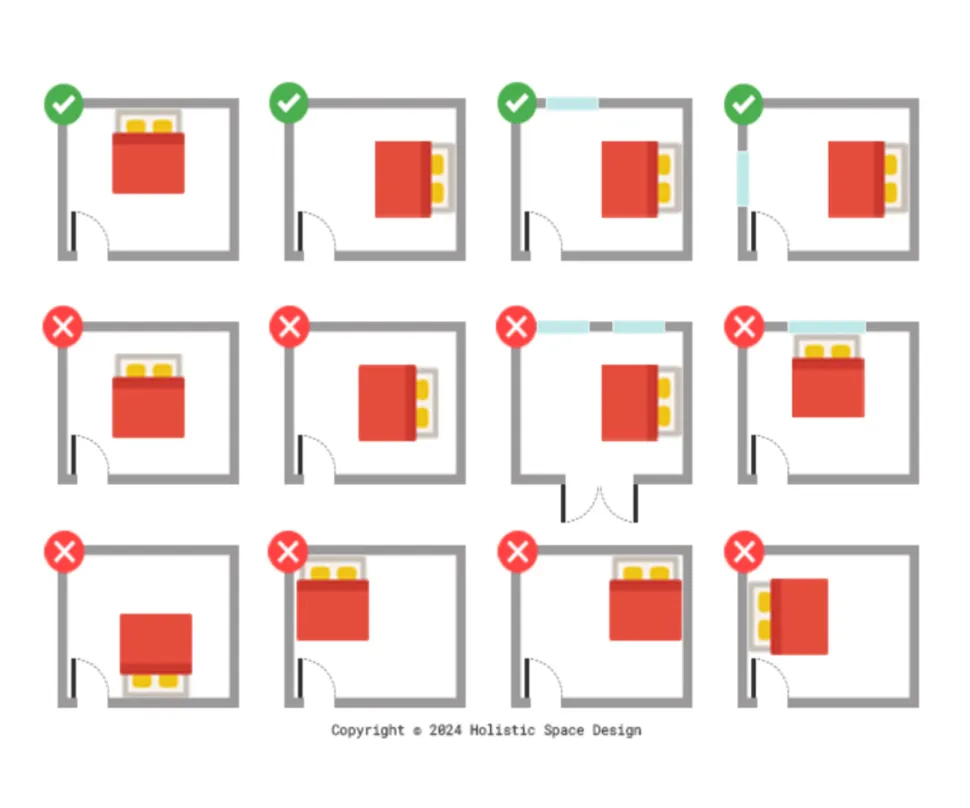 The idea of the commanding position is probably the most immediately applicable principle to help you feel calmer and more secure while occupying a space. This principle generally recommends specific placements of resting points (beds/desks/chairs) in rooms based on where openings (like doors and windows) are oriented.
- Avoid placing resting points directly in line with openings— you should have the option to either observe or ignore what’s going on outside. Mirrors can help to cover unavoidable blind spots.
- There should be a solid wall (or a window that can shut) behind your head, so that all openings are within your field of view.
- Use partitions to create cozier room sections where resting points are out of view from doorways.
- Place resting points (especially beds) away from heavy paintings, bookshelves, and other things that could injure you if they fell.
(want a video version with bedroom layout examples? this 1-minute short is cool!)
Another major principle of feng shui is balance, which can apply to interior design in a few concrete ways:
- Create a variety of restful, inactive spaces (like couches) and inspiring, active spaces (like kitchens).
- Balance colors, textures, and lighting (warm vs. cold, soft vs. hard, bright vs. dark).
A third principle is flow:
- Allow light and air to flow freely throughout spaces. Use windows/glass, create openings, and reduce clutter.
- More abstractly, the concept of energy (qi, 氣) materializes in concepts like the commanding position. The size and quantity of furniture in a room should also match the size and grandiosity of a room: both excess and lack of things to fill a room can feel disorienting.
- One feng shui rule I explicitly ignore is the recommendation to keep the space underneath my bed clear. While it does make the room feel more cluttered, I appreciate the functionality of the extra storage space too much to sacrifice it.
There are so many more nuances that I didn’t cover here or grossly oversimplified. If you’re still curious about feng shui, the Hong Kong skyline is wonderful little rabbit hole to jump into.
aesthetics
I’d argue that making a space beautiful is just as important as making it functional. What’s the point if you don’t feel at home in your own space?
colors
Choosing a color scheme for your room can make it feel more cohesive— but it can also feel like a daunting decision.
A good place to start is to use your anchor items (the largest/most expensive/hardest to replace items) to inform the rest of your room’s color choices. If your dining table is made of dark wood, you might consider buying more dark-wood-colored furniture to match it; if you have a large painting featuring reds and yellows, you could buy similarly-colored pillows.
Consider choosing one primary and one secondary accent color. The safest thing to do would be to make your primary and and secondary different shades of the same color (like light blue/dark blue, black/gray…), or similar colors (like blue/green, red/orange…).
Contrasting colors are risky, but make spaces feel interesting when done tastefully. You’ll have to play around with this to see where you want to draw the line. A mostly-green room with bright purple coasters could be cool, but a neon-pink-and-baby-blue checkered rug will probably end up tacky.
I’ve distilled my primary room colors into a color scheme that I share with my digital spaces (like bencuan.me!). My room mostly layers varying shades of green with light, natural wood colors and off-white fabrics. I also splash in a few blue items left over from my previous room, which was full of blue and dark-wood tones.
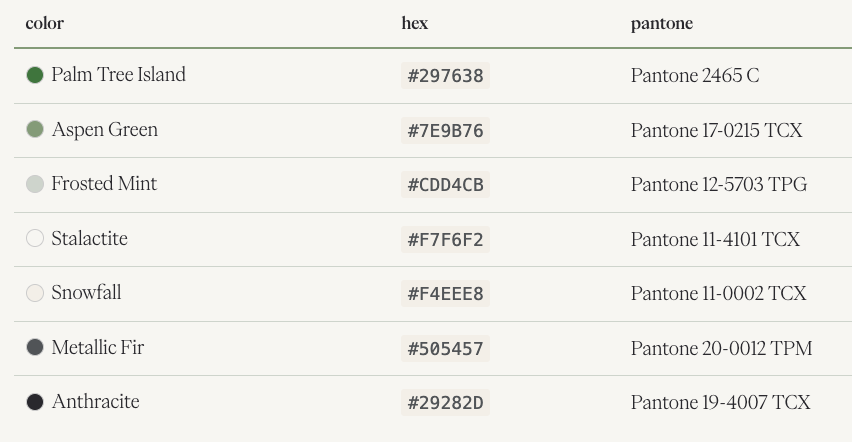 (i can’t yet afford real pantone swatches so i color-matched to the best of my ability with my monitor… one day though…)
grouping
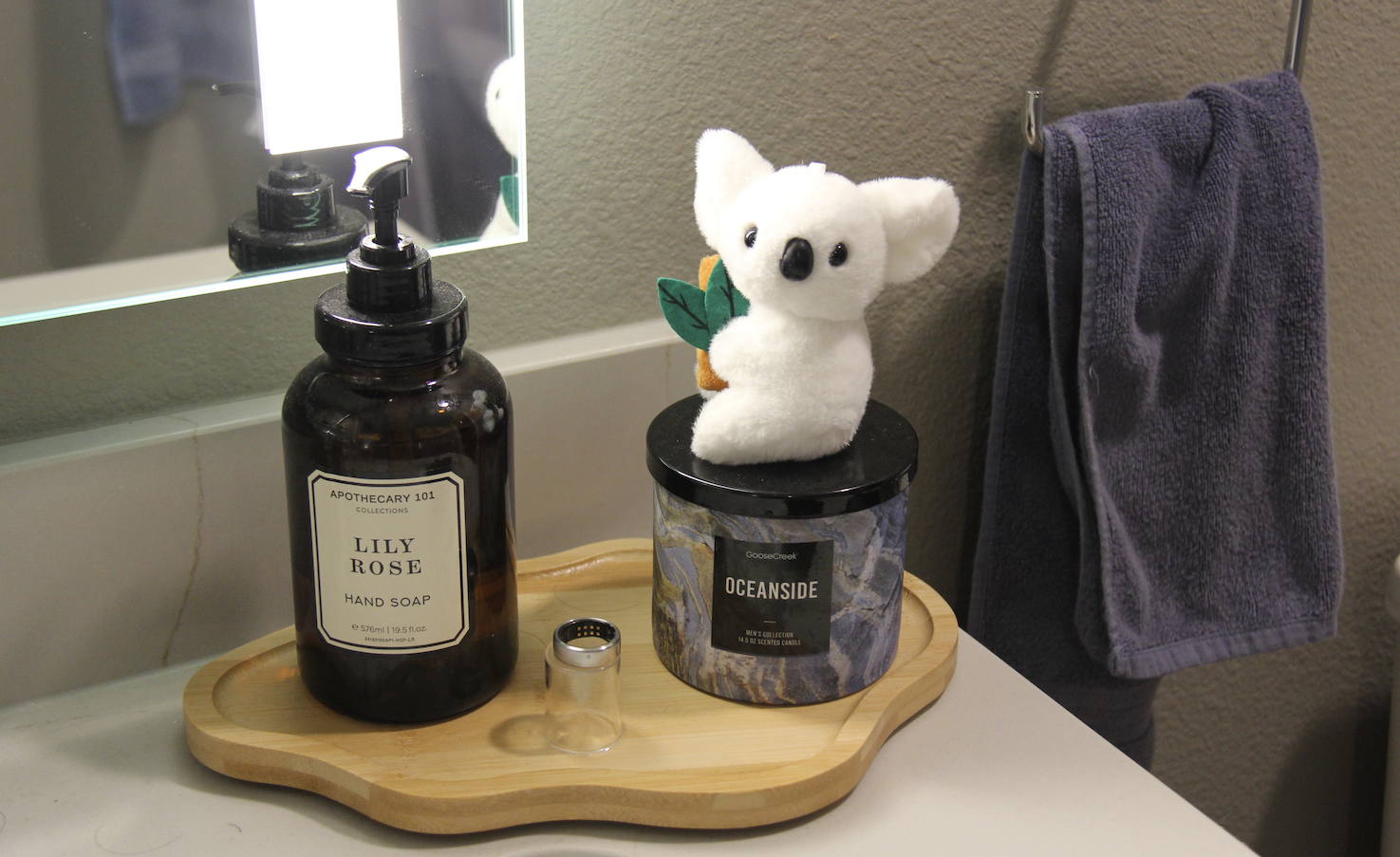 Adding more items can sometimes reduce clutter. Our brains are always trying to reduce cognitive load by grouping similar things together. By adding containers (or even just putting a bunch of items on top of a flat tray), we can trick ourselves into thinking that a whole bunch of unrelated stuff is actually one cohesive thing.
Not everything in a group needs to be useful or even cohesive. Consider adding a plant, cool sculpture, or candle next to something you grab for every day.
It’s pretty easy to find affordable decorative trays, plates, bowls, or any other type of container you can think of at any home goods store. I’d specifically recommend picking up this style of serving tray; they’re useful for moving around stuff in general, and look great even when not in use!
texture
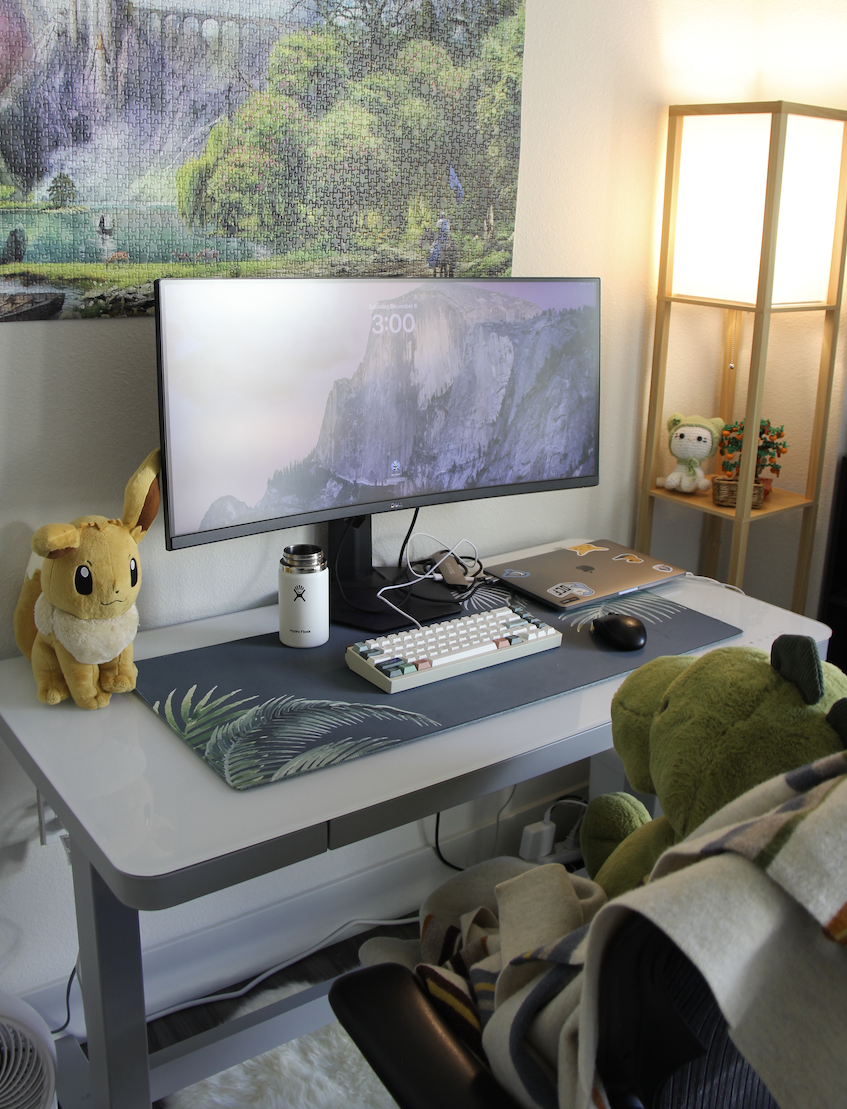 One of my favorite ways to make rooms feel more homey and put-together is to add furniture that features different types of textures. At my desk in the picture above, I have wood, glass, metal, and wool in roughly equal parts. Other interesting materials include mirrors/mirror-finish metals, paper (like lanterns or dividers), and leather.
Texture is also one of the most subjective of the various aesthetic choices you can make (I’d argue even more so than color). I don’t really have any concrete tips for balancing out material choices besides to play around with them a lot.
I’m a big fan of stuffed animals for many reasons, one of which is providing an easy way to add lots of varying, soft textures (and color!) to any room they occupy. And although I haven’t (yet) gotten into crocheting or amigurumi, I have a bunch of friends who are, and they’re one of my favorite gifts to receive! You can find cute things they’ve made in nearly every corner of the apartment.
the forgotten third dimension
 Hang stuff higher than you might think to. If I were to re-mount all of my wall decor, I’d move most of them a few inches higher.
Explore wall-mounted shelves and lighting. I don’t have many of these yet since I’m trying not to nail too many things into the apartment wall. But if I end up getting a place of my own in the future I’d strongly consider making better use of my wall space.
Find art that means something to you! Maybe this is an unpopular opinion, but I’d rather have blank walls than walls filled with generic art pieces.
- Over time, I hope to have the opportunity to commission pieces, highlight art that I or my friends have made, or otherwise assemble a collection of high-effort objects that have a deep personal connection.
- For now, I resort to puzzles as the closest thing to that ideal— they’re fairly high-effort (my 3000-piece living room puzzle took a few months to build), look cool, and also happen to be good conversation starters. At my last apartment, I almost always had an in-progress puzzle on the coffee table and visitors would contribute a piece or two; once it goes on the wall it’s meaningful to them, too.
furniture shopping
evaluating credibility
It was surprisingly hard for me to determine the trustworthiness of furniture distributors. This is partly because of how much money gets put into advertisements, and partly because the correlation between furniture price and quality is so weak.
I won’t recommend any specific brands here; I don’t trust my ability to make that call yet (and haven’t had any of my furniture long enough to evaluate their longevity). It’s worth spending some time to do a bit of research— here are some realizations that have helped me with that process:
I couldn’t find any meaningful correlation between the level of marketing and credibility of a company. Some viral brands (like Thuma or Revival) seem to me like they genuinely make good products for a reasonable price, whereas others (like Brooklinen or Ruggable) give the outward appearance of spending their entire budget on advertising over quality. As such, ads (especially on Instagram) can be a good way of discovering new sources of furniture as long as you’re not blindly trusting what they say.
Materials are a good baseline for quality. A solid wood piece of furniture is justifiably more expensive and more durable than an identical-looking one made of particle board. IKEA is a prime example of this: $50 rugs are listed alongside $500 ones because the former is made of synthetic materials while the latter might be hand-woven 100% wool. Be wary of high-end stores trying to upsell low-quality materials with name brands attached.
Influencers, redditors, and bloggers can’t be trusted at face value. Many of the corporate-owned (NYT Wirecutter) are egregiously and obviously sacrificing neutrality for affiliate ad revenue and tend to recommend overly expensive brands. (Take a look at this Wirecutter page on mattresses- sure if you’re looking to drop $2000 on a mattress this page is for you, but it gives the false pretense that’s what the average person should spend…). And, unlike other product categories like skincare or PC parts that attract a wide variety of enthusiasts, most Reddit posts about furniture seem to be extreme edge cases (unless a bed frame changed your life or almost killed you, why bother posting about it??)
Most high-end furniture stores are overpriced, but may be worth it in exchange for trust. If you get something from West Elm or Design Within Reach, you can be fairly confident that you’re getting a high quality item. But, you can often get something at 80% of the quality for 20% of the cost elsewhere. My favorite example of this is the Eames House Bird, which costs $500 from DWR. I’d totally grab one if I were ultra-wealthy, but I have to admit that the $50 Amazon replica looks almost identical and is also made of solid wood.
Watch out for white-labelled products. Many resellers (especially Wayfair, Home Depot, and Amazon) buy generically-manufactured products and bundle it with nice service (like big-box showrooms, return policies, and US shipping). However, the exact same product can end up with wildly different prices at various resellers. This video is a good introduction to what goes behind this practice and what you can do to make sure you’re not overpaying (and also how to watch out for dupes/scams, which are an entirely different thing).
used furniture
Most people get their used furniture from local online communities (Facebook Marketplace, Nextdoor, Craigslist…). This can be a fantastic way to get the good stuff for much lower than MSRP, and I’d generally recommend exploring them first before buying new furniture.
However, buying used furniture can be a lot of work since you have to actually go pick them up. If you have a small car (or no car), it’s probably not worth the hassle to rent a truck to grab a couch from 20 miles away, even if it is a few hundred dollars off.
Although I didn’t end up going this route for my latest move, I casually scroll through the listings every now and then. Now that I have a better frame of reference for what works well in my space, I can be on the lookout for very specific things to add.
Other ways of finding cheap furniture: ask family/friends what they want to get rid of; visit your nearest college campus on graduation week; go to a garage or estate sale; check auction or liquidation stores nearby. IKEA also has a used/returned section right next to their checkout section that I’ve had success with.
anchoring
I find that I feel ‘meh’ about nearly all furniture out there; it takes a lot of effort to find something that I feel really strongly about needing. But taking the time to find that one centerpiece can really bring an entire room together.
So far, the only ‘anchor’ item I’ve found is the Thuma bed. It most definitely feels overpriced for what it is (for example, KD Frames sells $300 bed frames that look almost as good!), but after many hours of attempts at searching for an alternative, I accepted that it was exactly what I was looking for. I’ve since surrounded the bed with very cheap Amazon furniture, but all of it looks great because they all compliment the style of the bed.
Finding anchors counterintuitively keeps budgets low by helping you feel good about purchasing mostly cheap furniture, allowing you to dedicate enough money towards a statement piece or two that you can be proud of (rather than a huge jumble of mid-priced things you feel just ok about).
my favorite objects
Here’s a list of random things I bought that worked surprisingly well for my specific needs. They are unlikely to be exactly what you are looking for, but maybe they’ll serve as a source of inspiration.
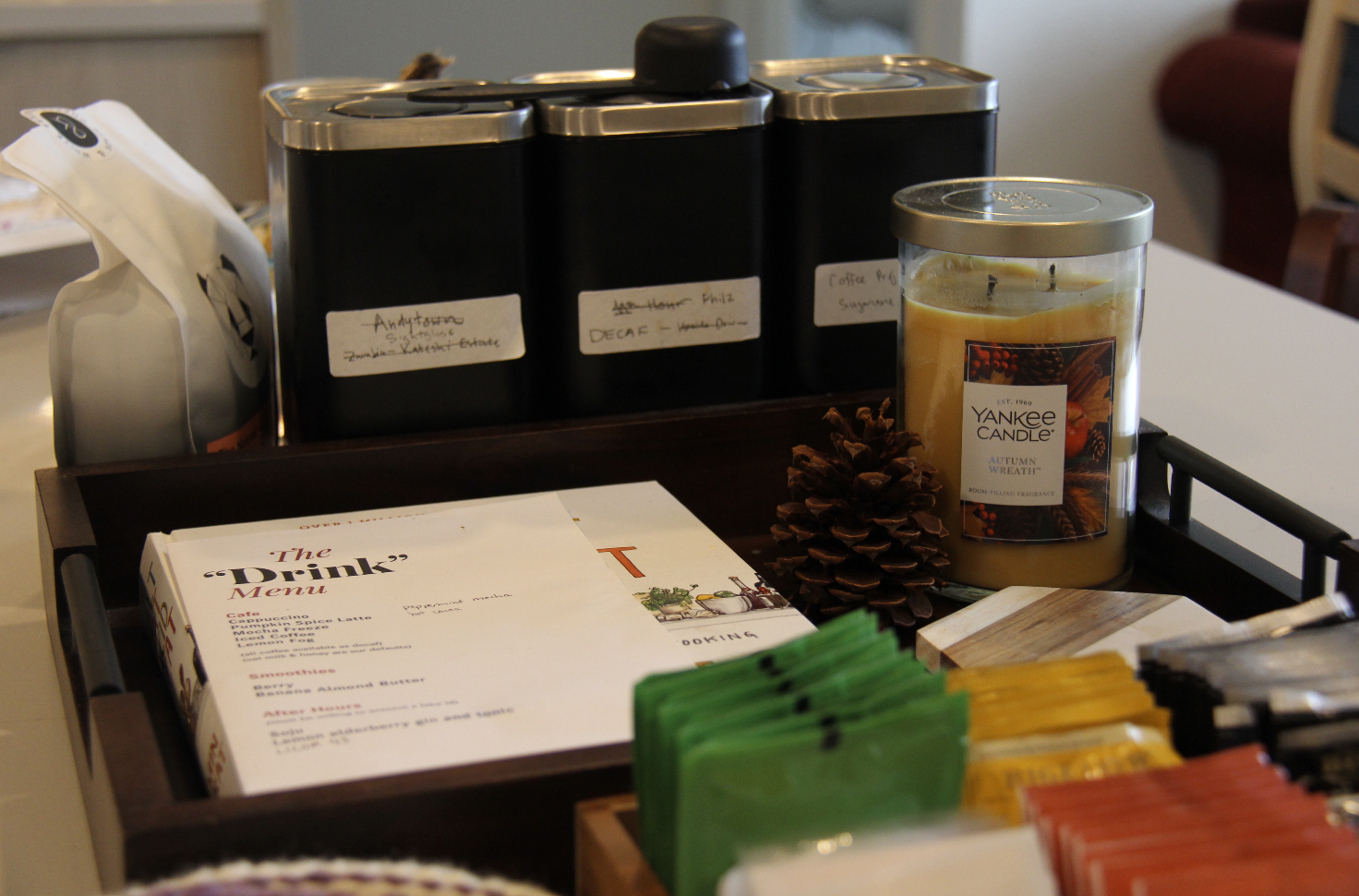 These airtight coffee canisters keep my beans fresh for longer while reducing clutter (looks a lot nicer to have a few of these rather than a bunch of half-open bags!). I also keep a pack of blank label stickers lying around for this purpose, which are useful for a wide variety of labelling needs.
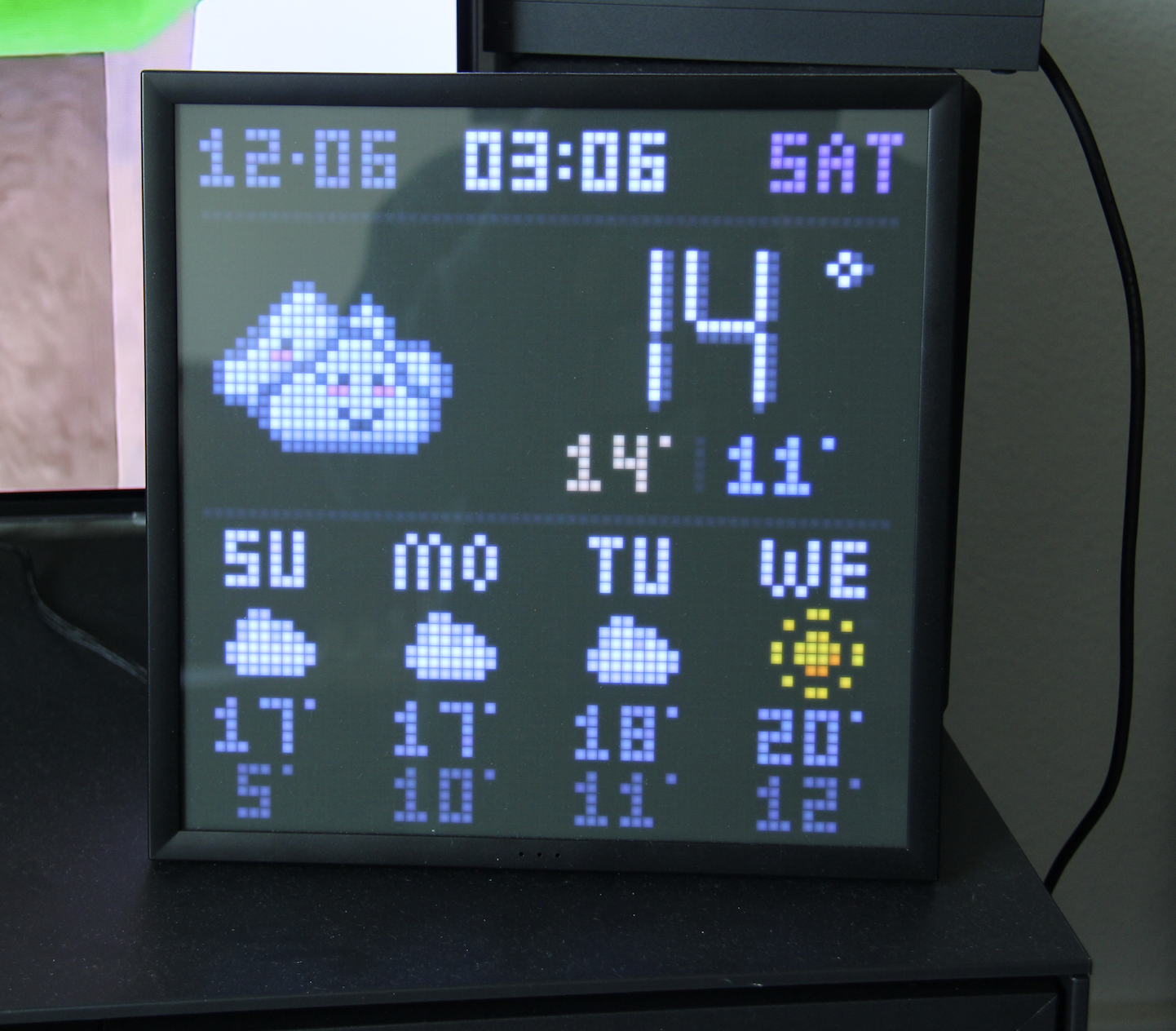 This customizable pixel board gets a lot of compliments and “where did you buy that? I want one too!” comments. My roommate got this on a whim and now it’s a mainstay of the living room. (It’s also a great holiday gift!)
If you can afford splurging on a nice blanket, getting a Pendleton throw (or other vintage-style wool blanket) is a fantastic way to add some color and texture to a room. I was very skeptical of paying $100 for a wool square, but given how often I use it and how cozy it feels it was totally worth it for me.
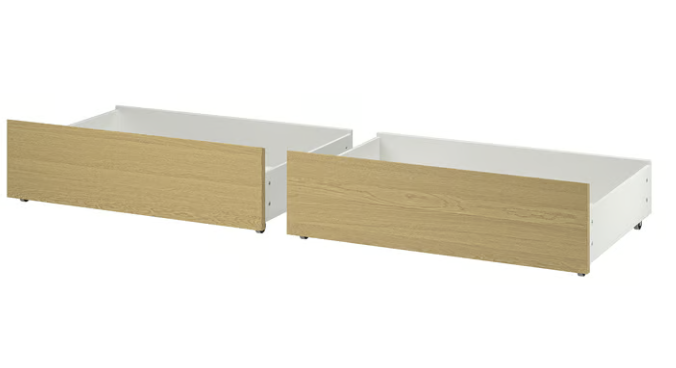 From IKEA:
- The MALM under-bed drawers (pictured above) are a classy yet affordable way to increase your storage capacity. The oak veneer is not 100% a perfect match for my bed frame, but it’s so close that it looks like it came with it.
- STOPP FILT has so many uses: pad your furniture while moving; slide them under your rugs; use as a super high-friction gripping material for furniture assembly or jar opening. Grab a few and keep them in your closet!
- Two side-by-side BILLY bookshelves fit perfectly in my living room nook and look many times more expensive than they actually are. This product is probably one of IKEA’s greatest achievements.
- Although I already discussed this in the designing maintainable spaces section, the SKÅDIS deserves another shoutout.
further exploration
Here are a few resources I’ve found that have helped me throughout my learnings. As I’ve mentioned previously, I’m not particularly confident in my ability to determine the credibility of interior design influencers on the internet, so take these with a grain of salt. At the minimum, they might be a good place to kick off your own exploration.
- I’ve enjoyed Caroline Winkler’s content; her videos are quite entertaining and she does have some good tips floating around. It’s cool to see what her design process looks like from her various videos about transforming subscribers’ homes.
- I like Matthew Encina’s design taste a lot. I learned about him first through keyboards (he’s now Mode’s brand designer!) but he also makes a lot of videos about his home office. I first learned about the SKÅDIS through him.
- While I was writing this, Causally Explained released a video about interior design! Although mostly a joke, I unironically believe in his prediction that art deco is going to make a comeback in the next decade.
- Find people near you who have good taste, try to see the implicit decisions they make with their own space, and ask them where they get their furniture :)